October 5, 2026 · The Data Product Agent
The Middle of Product Management Is Disappearing
For a long time, two product managers could sit at the same level, carry the exact same title, and be treated as equals even when the value they created was completely different.
One could move from the customer problem into the data, get into the technical constraints, challenge the experience, work through the tradeoffs, and then walk into a leadership conversation and help make the decision. The other could manage the process around all of those things: keep the roadmap current, run the meetings, coordinate the handoffs, clarify the requirements, and make sure the team kept moving.
Thanks for reading! Subscribe for free to receive new posts and support my work.
Both could be useful, and both could build successful careers. But I do not think that gap stays hidden much longer.
Product management is becoming an 80/20 profession. I do not mean that 80 percent of PMs are about to lose their jobs. I mean the distribution of value is getting much more extreme, rather than following the relatively comfortable bell curve we have gotten used to. A smaller group of product managers will be able to create a disproportionate amount of impact, and the difference between strong product managers and average ones will become much easier to see.
A lot of what we have historically called good product management is becoming table stakes. Being organized matters. Writing clearly matters. Managing stakeholders matters. Running a good process matters. None of that goes away.
It just stops being enough.
Product management grew up in the seams
Product management became important because modern organizations became incredibly specialized. Engineering understood the system. The business understood the problem. Design understood the experience. Data lived somewhere else. Leadership was trying to reconcile all of it from another level entirely.
Someone had to connect those worlds, and product managers became very good at doing exactly that. We translated, clarified, sequenced, documented, prioritized, and kept information moving through organizations that often made collaboration much harder than it needed to be. That work created real value. I have spent plenty of my own career doing it.
But there is an important difference between creating value because you have exceptional judgment and creating value because the organization has expensive seams.
A lot of product management has existed inside those seams, and that is precisely what is changing today.
The cost of getting to a first answer is falling. The cost of analysis is falling. The cost of prototyping is falling. The cost of turning an idea into something tangible is falling. Information that used to require a chain of meetings, requests, and handoffs can increasingly be accessed and acted on directly.
AI obviously accelerates this, but I think the larger shift is about capability. Engineers can get closer to customer context. Designers can build. PMs can interrogate data directly. Analysts can create applications. Business leaders can get to information without waiting for someone to build the perfect dashboard first.
The functions are not disappearing. The distance between them is getting shorter.
That matters because the traditional PM benefited from that distance. The more fragmented the organization, the more valuable it was to have someone coordinating the pieces. As those seams get cheaper, the value of simply sitting between the functions goes down, while the value of being able to operate inside them goes up.
The role is recombining
I do not think the answer is that every product manager needs to become a software engineer. That is too simple.
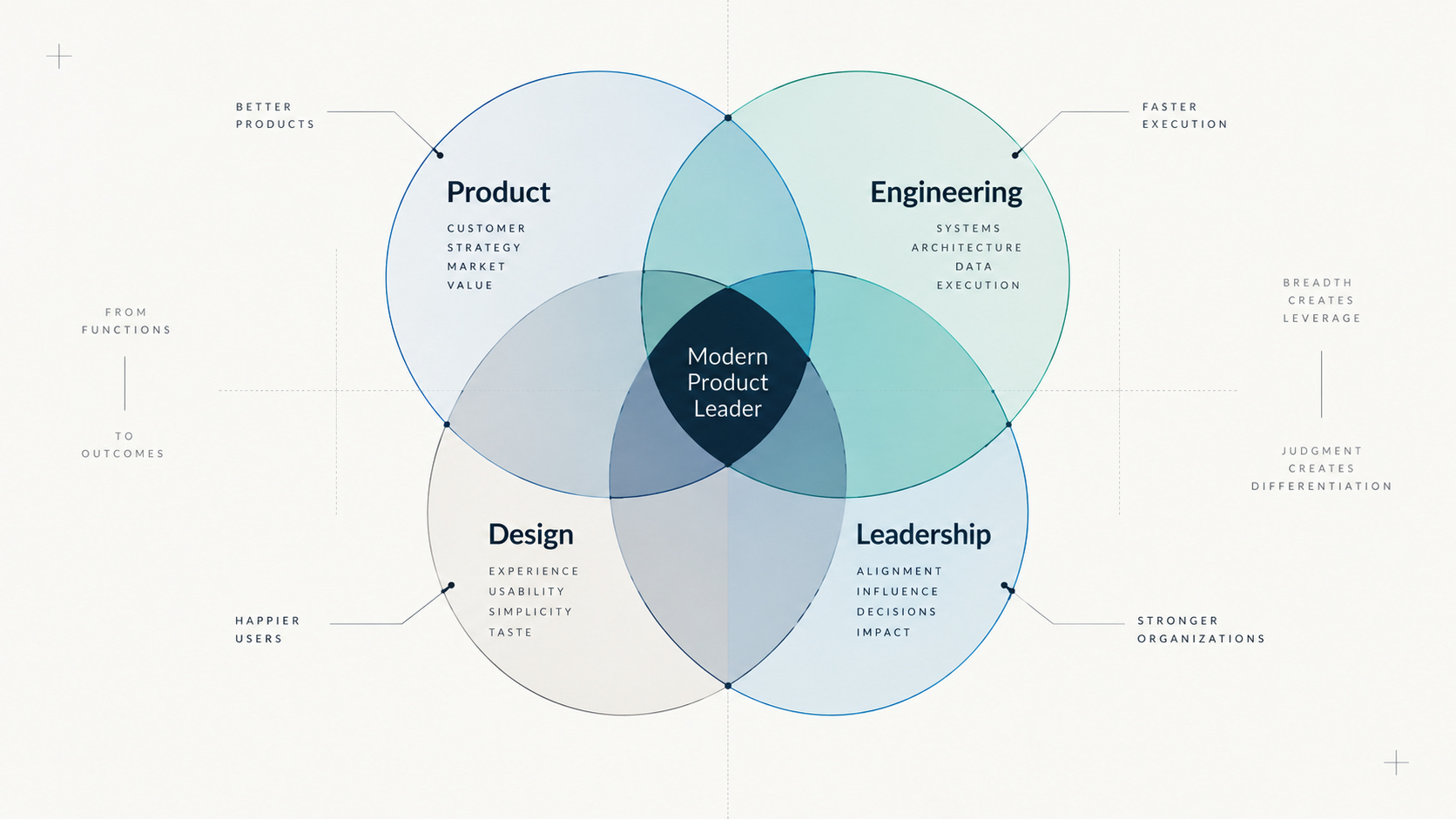
What I see instead is a recombination of Product, Engineering, Design, and Leadership. The strongest PMs are increasingly credible across all four. That does not mean they are equally deep in each one. It means they can move across the system without needing every conversation translated for them.
On the technical side, that means understanding enough to participate in the real discussion. You should be able to reason about architecture, data, APIs, technical debt, AI systems, constraints, and tradeoffs. You should understand why something is hard, not just that engineering says it is hard. You should be able to get close enough to the implementation to challenge assumptions and recognize when a technical constraint is real versus when the team has simply inherited a way of working.
More importantly, I think strong PMs will increasingly build things themselves. Not production systems and not as a replacement for engineering, but prototypes, workflows, analyses, internal tools, agents, and rough versions of ideas that make the conversation more concrete.
The distance between a thought and a usable first version has become too short to justify handing every idea over the wall. A PM who can walk into a technical conversation with something tangible is operating from a very different position than one who arrives with a document describing what someone else should build.
The same thing is happening with design. The PM does not need to become the designer, but the PM needs taste.
Taste is easy to dismiss because it sounds subjective, but it becomes more important as execution gets cheaper. When almost anyone can produce something functional, the scarce capability becomes knowing what is worth producing in the first place. You need to know when something technically works and still feels wrong, when a workflow is too complicated, when the team has solved the wrong problem elegantly, when a feature adds more cognitive load than value, or when the best product decision is to remove something instead of adding another layer.
Building gets cheaper while judgment does not.
That is why I think the future of product management is bigger than “PMs need to code.” Technical depth matters, but so does knowing what good looks like.
And then there is leadership. Not people management. Leadership.
Can you create clarity when there is no obvious answer? Can you make a decision when the data is incomplete? Can you challenge engineering when the technical answer protects a bad product outcome? Can you recognize when engineering is right and the business simply does not like the answer? Can you tell a senior stakeholder that the thing they want is not actually the thing the organization should prioritize?
More importantly, can you move people with different incentives toward a decision none of them would have reached independently?
The strongest PMs are not just facilitating those decisions anymore. They are materially improving them, and that is a very different standard.
There are fewer places to hide
For years, product organizations built more structure around the discipline. We created clearer career ladders, stronger discovery practices, prioritization methods, product operations, roadmapping standards, certifications, frameworks, and increasingly specific definitions of what a PM should and should not own.
A lot of that made the profession better. It also made it possible to become very good at the mechanics of product management without becoming unusually good at anything else.
You could become a professional PM. You knew the process. You knew the vocabulary. You knew how to facilitate. You knew how to write the document, run the meeting, maintain the roadmap, and keep the team aligned.
For a while, that could be enough. I do not think it will be for much longer.
The future is not a world where every PM becomes a vague generalist who is decent at everything. That would be just as weak. You still need a spike.
Some PMs will be deeply technical and thrive in data, platforms, infrastructure, AI, developer products, and other complicated technical environments. Some will have exceptional product taste and understand users, workflows, and markets better than almost anyone around them. Some will be unusually strong operators and leaders who can navigate ambiguity, make difficult calls, and move complex organizations forward.
The best will probably combine more than one. What becomes harder is having no spike at all.
For a long time, being good at product management could itself be the spike. I am not sure it can be anymore.
The mechanics are becoming cheaper. The artifacts are becoming cheaper. The coordination is becoming cheaper.
The judgment is not.
The career path starts to split
This is where I think the profession gets interesting.
One path leads toward the high-level individual contributor. We are going to need more Staff and Principal-level product people who stay close to the work, own increasingly large and complicated problem spaces, and become exceptionally good at navigating the overlap between technology, product, and the business.
Some will be technical. Some will be tastemakers. Some will be both. They may never need to manage a large team to justify their seniority because their leverage comes from the quality of the systems and decisions they shape.
The other path leads toward broader ownership.
If you become strong across product, technology, design, and leadership, you are building a skill set that starts to look less like traditional product management and more like general management. That is where the path toward GM, CPO, founder, or CEO starts to make sense.
Not because the PM is the “CEO of the product.” I have never found that framing particularly useful.
It is because the best product work teaches you to understand an entire system. Customer needs, technology, economics, organizational constraints, experience, sequencing, and tradeoffs all have to come together in one decision.
That is executive work in miniature.
I do not think product management is dying. I think the comfortable middle of product management is.
The PM whose primary value is being organized, articulate, and good at running the process will have a harder time differentiating themselves from the people around them. The PM who can get technical when needed, recognize what good looks like, understand the business, and lead through ambiguity will become much more valuable.
That is why I keep coming back to the 80/20 idea. This is not primarily a headcount story. It is a leverage story.
The strongest product managers are gaining the ability to do more, move faster, and operate across more of the system than the role traditionally allowed.
And that leaves a harder question than whether AI is going to replace product managers.
What are you actually great at?
Because being good at product management is probably not going to be enough.
Thanks for reading. Subscribe for free to receive new posts and support my work.
Thanks for reading! Subscribe for free to receive new posts and support my work.