December 1, 2025 · The Data Product Agent
Workflow Is the Real Unit of Organizational Transformation
The thing no one wants to admit: organizational transformation fails because we skip the workflow layer.
I’ve led data and AI platform work across multiple studio groups inside a large enterprise. I’ve rebuilt workflows across functional areas. I have watched initiatives with a well-crafted strategy and solid tech stack completely stall out - not because people didn’t do what they needed to do, or weren’t qualified for the role, but because we never thought about how the work really moves.
Leaders focus on org charts, roadmaps, and culture. All of that matters. But if the workflow stays broken, nothing else sticks.
Here’s the truth: Technical isn’t the hard part. The people are. And the way you change how people work is by redesigning workflows—not once, but continuously.
The Hidden Truth About Transformation
Workflow Is Where Change Actually Happens
Org charts show reporting structure. Roadmaps show priorities. Strategy documents show direction.
But workflows show the truth:
Who really makes decisions
Where bottlenecks start to form
Which handoffs create the most confusion
Where context gets lost between teams
The pattern I see everywhere: Organizations try to change outcomes without changing the workflows that drive them. They launch new tools, reorganize teams, rewrite strategies—but the actual mechanical process of how work moves stays exactly the same.
Redesigning workflows doesn’t just swap out tools or change outcomes. It changes how people actually work. That’s the hard part.
The 6 Invisible Blockers Killing Team’s Velocity
1. Unclear Ownership
The problem: “Who actually decides this?” has three different answers depending on who you ask.
What it costs: Meetings that circle endlessly. Decisions that get made and then unmade. Thirty minutes debating tactical questions because no one is sure whose call it is. People get frustrated, both with wasted work and delayed deliverables.
2. Scattered Handoffs
The problem: A single request touches six people or even multiple teams before anyone does real work.
What it costs: Each handoff adds delay and degrades context, requirements, and the definition of success. By the time execution starts, the team is solving a different problem than the one that was asked.
3. Shadow Decision-Making
The problem: The real call happened in a one-on-one after the meeting or in a one-off chat in the kitchen area. Everyone knows the official process is just for the sake of the “process” - but why?
What it costs: The workflow doc says one thing, but reality is entirely different. People game the system, it becomes about the squeaky wheel or the leader who presses first - but not about value or impact.
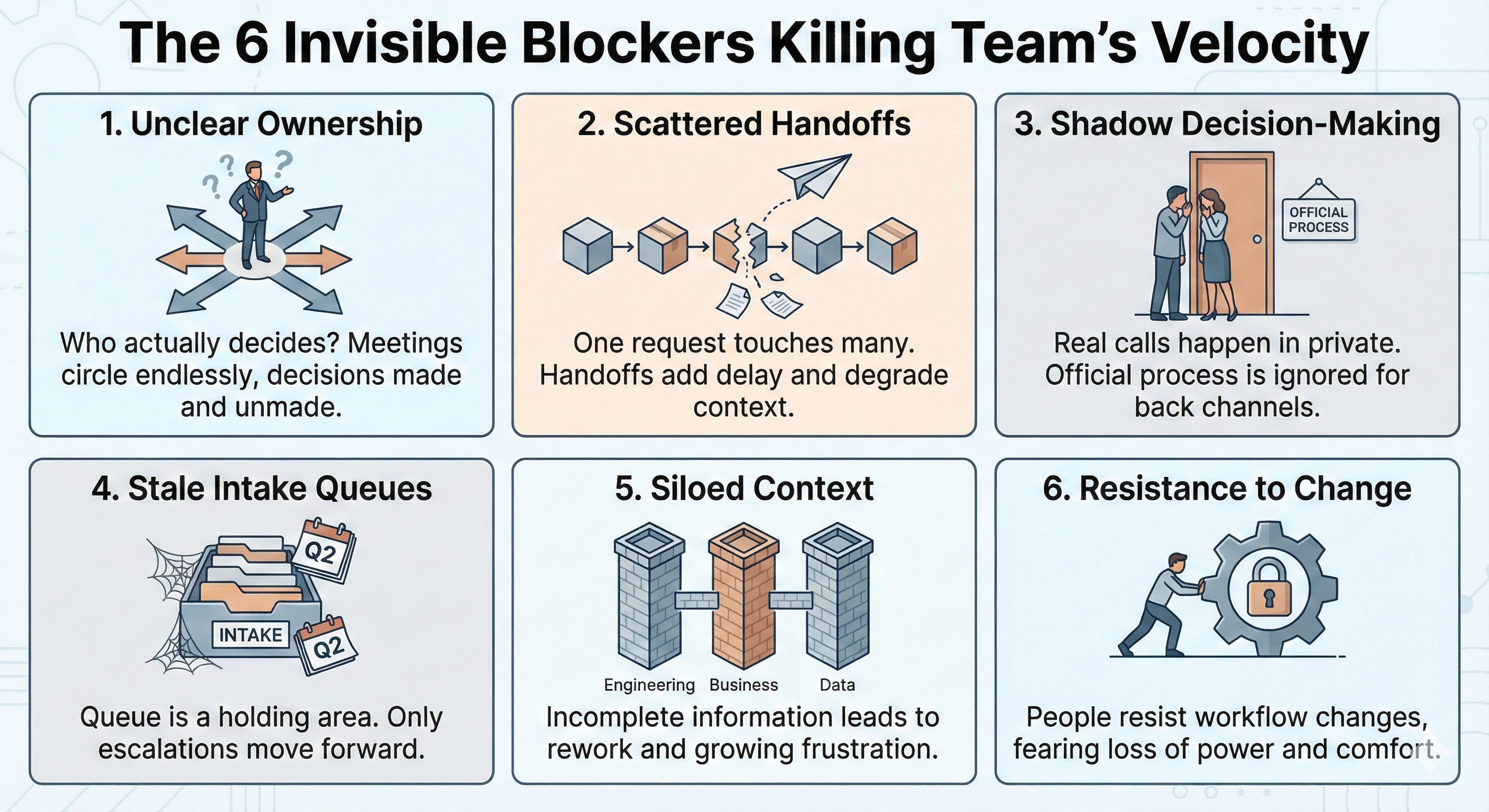
4. Stale Intake Queues
The problem: You’re still working through Q2 requests. Not because you’re slow—because intake wasn’t designed for decision-making.
What it costs: The queue becomes a holding area. Nothing moves unless someone escalates through a back channel. This leads to questions about what is still relevant to deliver, and the WHY is always a moving target because you are a quarter or more behind on deliveries.
5. Siloed Context
The problem: Engineering doesn’t know what the business needs. The business doesn’t know what’s technically feasible. Data teams don’t know what’s already been built.
What it costs: Everyone works hard with incomplete information. Rework piles up, and frustration grows across the organization and throughout different levels.
6. Resistance to Change
The problem: People resist changing workflows even when the current way is demonstrably broken.
What it costs: Every workflow improvement gets delayed, watered down, or quietly ignored—because changing workflow means changing power, autonomy, and comfort.
Why “Technical Isn’t the Hard Part”
The Real Blockers Are Human, Not Technical
I’ve never seen a workflow improvement blocked by technology; there is always an option or solution that will get the job done. On the other hand, I have seen many blocked by people.
Not because people are difficult. Because they have reasons—good reasons from their perspective—to resist.
The 4 Types of Resistance You’ll Face:
“We’ve always done it this way.”
Translation: I’ve built expertise around the current process. If we change it, I lose that advantage and “power”.
“If we standardize intake, I lose my direct line to leadership.”
Translation: The current workflow gives me influence and visibility. The new one distributes it differently, and it scares me.
“My team is measured on throughput, not outcomes.”
Translation: The incentive structure rewards the old behavior - why would I change?
“I don’t believe this new process will actually work.”
Translation: I’ve seen other initiatives fail. Why should I invest effort in this one?
The Leadership Tension
You need to trust people and give them autonomy, but you also need to push the organization forward and keep everyone aligned - all at the same time.
This is the tension: workflow transformation requires changing real human behavior
Real example: I led a workflow redesign that stalled for almost two quarters. The new process was much simpler, clearer for both engineering and leadership, and more efficient at every turn. But one key stakeholder felt it would reduce their visibility to leadership, which led them to block the momentum and stick to how things “had always been done”. They’d built their career by being responsive to ad hoc dashboard requests, and the new workflow made decisions more transparent but less personal.
We moved forward only after creating a new role that maintained visibility while distributing decision-making authority. The technical work took two weeks. The people work took almost six months.
Workflow transformation is as much about psychology and power dynamics as it is about process design.
The Dependency Chain Most Organizations Miss
Workflow → Product → Platform → AI
You can’t skip steps because each layer depends on the one below it.
Clear workflows enable product thinking.
If you don’t know how requests flow or how decisions get made, you can’t design products that serve real needs. You build what gets asked for, not what solves the underlying problem.
Product thinking enables platform adoption.
Platforms only scale when they solve problems teams actually have. Without product discipline, platforms feel like overhead.
Platform adoption enables consistency.
Shared infrastructure creates interoperability, reusability, and cumulative improvement. Data quality improves. Onboarding accelerates.
Consistency enables AI and automation.
AI doesn’t fix chaos—it magnifies it and then scales it. If workflows are inconsistent, automating them creates inconsistent automation. If data is messy, models produce messy outputs.
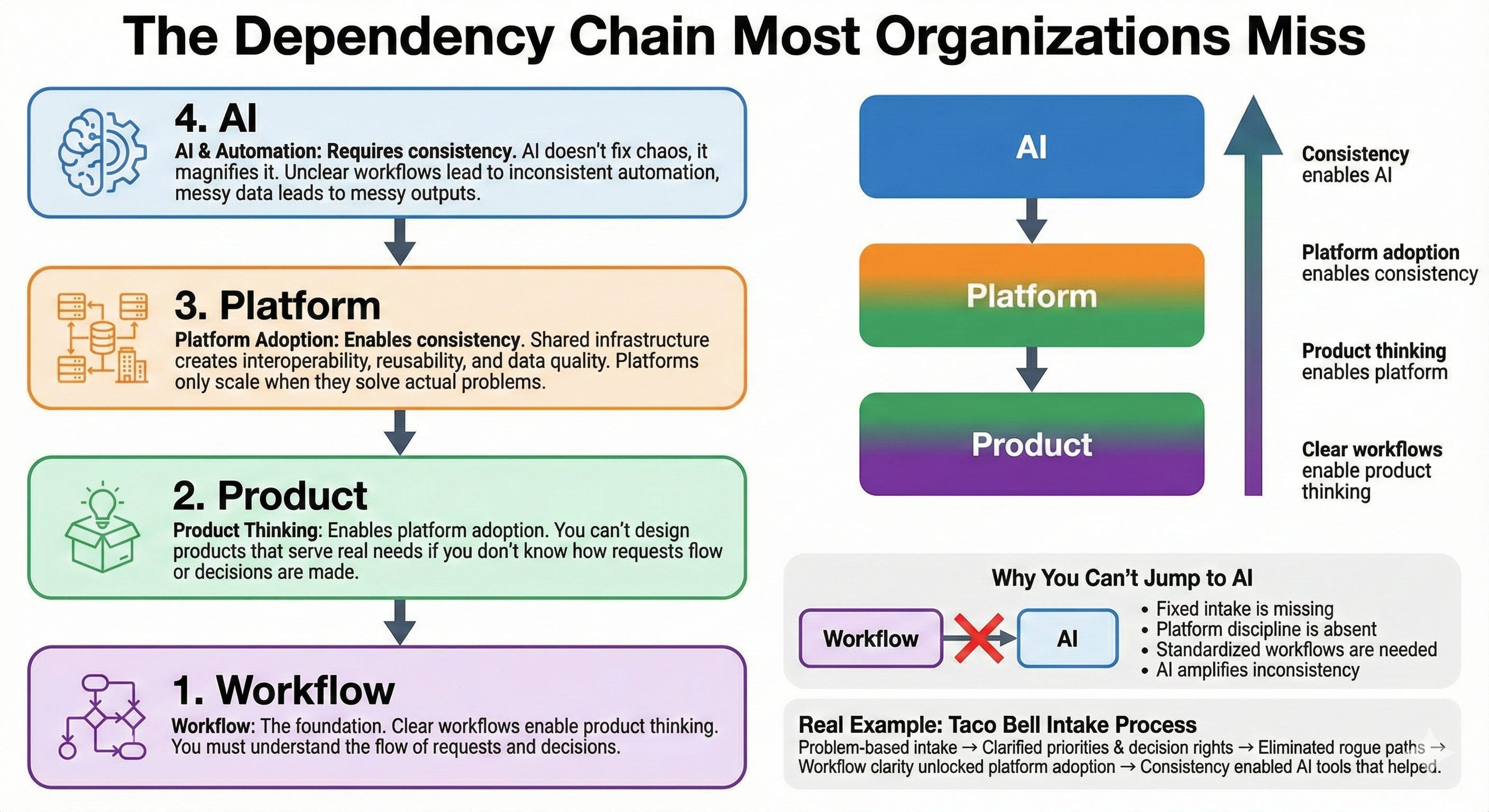
Why You Can’t Jump to AI
Organizations want to skip straight to AI because that’s where the value is, or at least the perceived value.
But they haven’t:
Fixed intake, so the AI doesn’t know what problem it’s solving.
Built platform discipline, so the AI can’t integrate.
Standardized workflows, so the AI amplifies inconsistency.
[Side note: this doesn’t even begin to mention the issues with the data foundation and AI strategy that have to be decided long before the workflow and outcome-focused AI plans.]
Real example: We rebuilt the intake process for one of my teams at Taco Bell. Made it problem-based instead of request-based, clarifying guidelines for priorities and more transparent communication through clarified decision rights. Eliminated the existing rogue paths and one-off Slack messages. That workflow clarity unlocked platform adoption—teams trusted the platform because the workflow made their needs explicit. Platform adoption created consistency in how we used data. That consistency enabled the deployment of AI tools that actually helped.
Workflow is the foundation.
The Biggest Mistake: Treating Change as Episodic
Most Organizations Think Change Management Is a Project
The pattern:
Big initiative coming (new tool, new process, reorg).
Run training sessions, send communications, and appoint change champions.
Declare victory at launch.
Six months later, everyone’s back to the old way.
The problem: Change management was episodic rather than continuous.
Episodic vs. Continuous Change Management
Episodic change management treats transformation as a project with a beginning, middle, and end. You plan it, execute it, close it out. The assumption is that once people learn the new way, they’ll just keep doing it. Every shift requires another big initiative—more training, more communications, more disruption. Change is rare and painful.
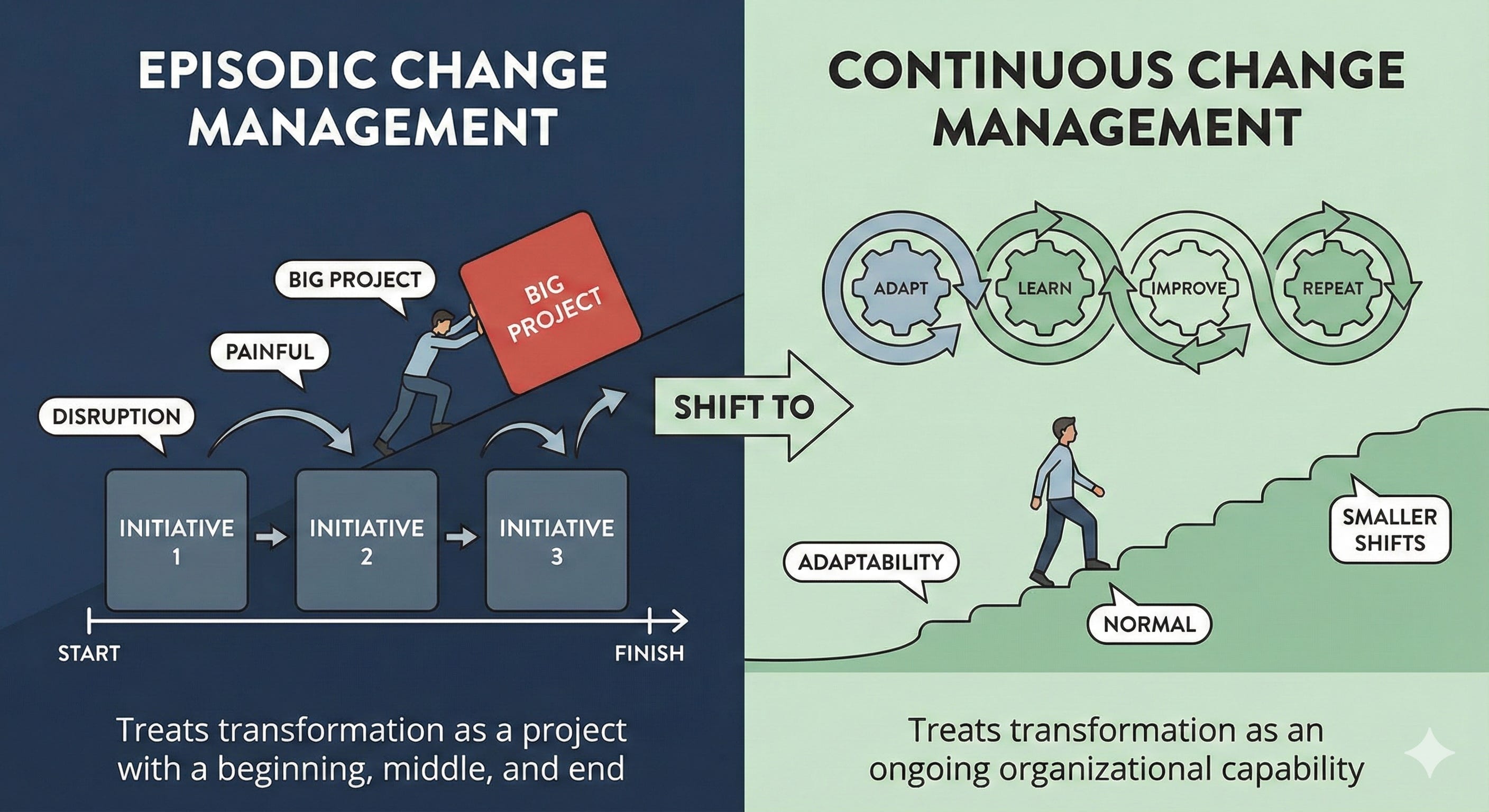
Continuous change management treats transformation as an ongoing organizational capability. The assumption is that the right way to work today won’t be the right way to work next quarter, so adaptability itself becomes the skill you’re building. Shifts become smaller, faster, and less disruptive because the organization already has the muscle to adapt. Change is normal and expected.
What Continuous Change Management Looks Like
Regular workflow retrospectives
Every quarter, month, or sprint: What’s slowing us down? Where is the process breaking down? What should we stop doing or start doing differently?
Explicit feedback loops
After major handoffs: How did that go? What would have made it better, or what just didn’t work at all?
Safe space for process improvement
People won’t report their problems if they’ll be punished for doing so or if it’ll circle back around to them. If the message is “just follow the process,” improvement stops because the thinking stops. If the message is “help us make this better,” you get continuous evolution and true buy-in from teams.
Leadership that models adaptability
When workflows break, we change them. I’ve redesigned processes three months after launching them. That’s not failure—that’s iteration.
Real example: I rebuilt a workflow six months ago. We’ve iterated on it four times since then. Each iteration was small—someone found a faster route for certain requests, another person identified a decision point we could eliminate. The compounding effect has been huge: we’re faster, clearer, and people trust the process because they see it evolving with them.
The Truth About Agility
Companies that treat change as continuous outperform companies that treat it as episodic. Not because they’re smarter or better resourced, but because they’ve built the muscle to adapt.
Your job as a leader isn’t to finish transformation. Your job is to build an organization that can continuously transform itself.
The 5 Patterns That Separate Organizations That Transform
1. Leadership Aligns on Workflow, Not Just Strategy
Most leadership teams align on what they’re trying to achieve, but fewer align on how that same work actually moves from team to team through the organization.
What this looks like:
Leaders map the current state first—where work actually goes, not where it’s supposed to go. They identify real bottlenecks, real decision points, real handoffs. Then they align on what needs to change.
2. Intake Is Problem-Based, Not Request-Based
Most intake systems collect tasks or simple requirements that give no clear insight into the WHY or HOW of the request: “Build this dashboard for x, y, z KPI”, “Pull this data”, “Create this report”.
Problem-based intake asks: “What decision are you trying to make?” “What outcome are you trying to achieve?”
The shift: Task-based intake turns teams into order-takers while problem-based intake turns them into problem-solvers and thought partners.
Real example: I rebuilt the intake around this exact principle. Instead of accepting requests as stated, we pushed back: What problem does this solve? Have we already solved something similar? Half the time, the real need was different from the stated request. Result: less rework, faster delivery, better outcomes.
3. Teams Eliminate Rogue Paths and Invisible Work
Every organization has shadow workflows—the “I’ll just ask Sarah directly” paths that bypass the official process.
Why they exist: The official process is too slow, too bureaucratic, or doesn’t serve the actual need (or even worse, people just don’t know the process).
What they cost: Inequality (people who know Sarah get faster service) and instability (when Sarah leaves, the workflow breaks).
What works: Don’t just ban rogue paths—design workflows that make the right path the easy path. If people are bypassing intake, intake is broken.
4. Decision Rights Are Explicit
Who owns this decision? Who needs to be consulted? Who needs to be informed?
Most organizations can’t answer these clearly. I’ve watched decisions ping-pong for weeks because no one was sure who had final say.
What this unlocks: When everyone knows who owns what, decisions happen faster with less confusion and less rework. And when decision rights need to change, you can change them deliberately instead of letting them drift.
5. Change Is Treated as Continuous, Not Episodic
Teams that adapt don’t wait for big initiatives. They:
Build feedback loops into the workflow itself.
Reflect regularly.
Iterate quickly.
Treat every workflow as a draft, not a decree.
The difference: Teams that adapt treat every handoff as a chance to learn and improve. Teams that get stuck treat workflows as fixed and wait for someone senior to declare a change.
Your Workflow Redesign Framework
8 Steps to Fix How Work Actually Moves
1. Map the current state
Don’t map what the process doc has documented. Map out what actually happens. The easiest way is to follow a real request from start to finish, maybe even a few.
2. Identify the bottlenecks
Where does work slow down, loop back, or just straight disappear? Is it unclear ownership? Too many handoffs? Missing information? Try to find the gap.
3. Name the people problem
What behavior is blocking improvement? Why? This isn’t blame—it’s understanding incentives, fears, and power dynamics.
4. Reduce unnecessary steps
Eliminate handoffs that don’t add value. Every time work moves between people, you lose context and add delay.
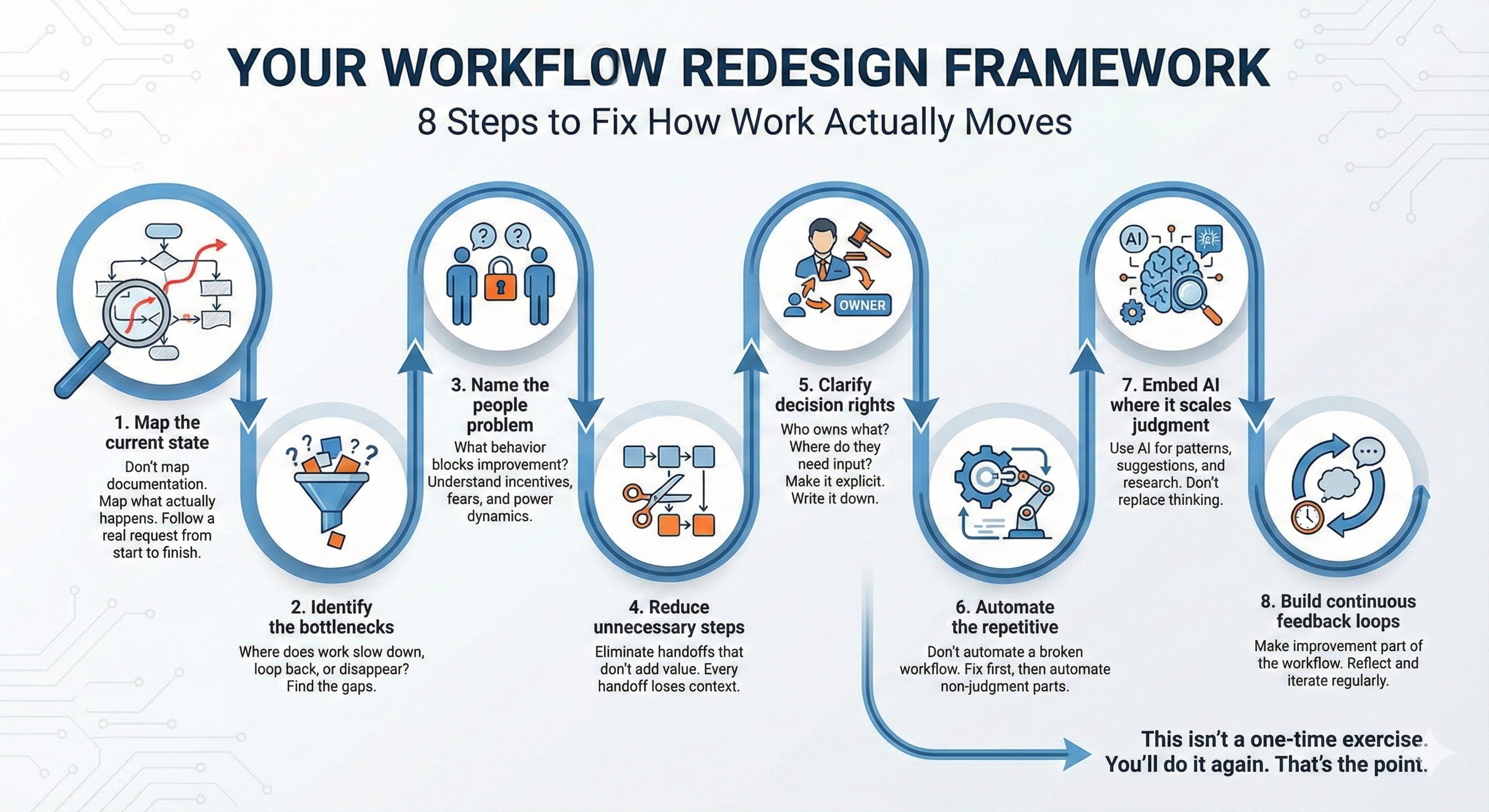
5. Clarify decision rights
Who owns what? Where do they need input? Where do they have final say? Make it explicit. Write it down. Enforce it.
6. Automate the repetitive—but only after steps 1-5
Don’t automate a broken workflow. Fix the workflow first, then automate the parts that don’t require judgment.
7. Embed AI where it scales judgment
Use AI to surface patterns, suggest next steps, and accelerate research. Don’t use it to replace thinking.
8. Build continuous feedback loops
Make workflow improvement part of the workflow itself. Reflect regularly. Iterate quickly.
This isn’t a one-time exercise. You’ll do it again in six months. That’s the point.
Where Technology Fits (and Where It Doesn’t)
Technology Is a Multiplier, Not a Solution
Snowflake makes data accessible—if your workflows define what data people need and how they should use it.
Immuta enforces governance—if your workflows establish clear data policies.
Alation documents assets—if your workflows consistently create them.
Cortex enables AI—if your workflows support structured decision-making.
The Pattern I Keep Seeing
I’ve stood up platforms that teams didn’t adopt because intake was still broken. The platform worked perfectly. But if the workflow doesn’t route the right problems to the right people with the right context, the platform just sits there.
Technology amplifies workflow clarity. It doesn’t replace it.
Fix the workflow first. Then add the tool.
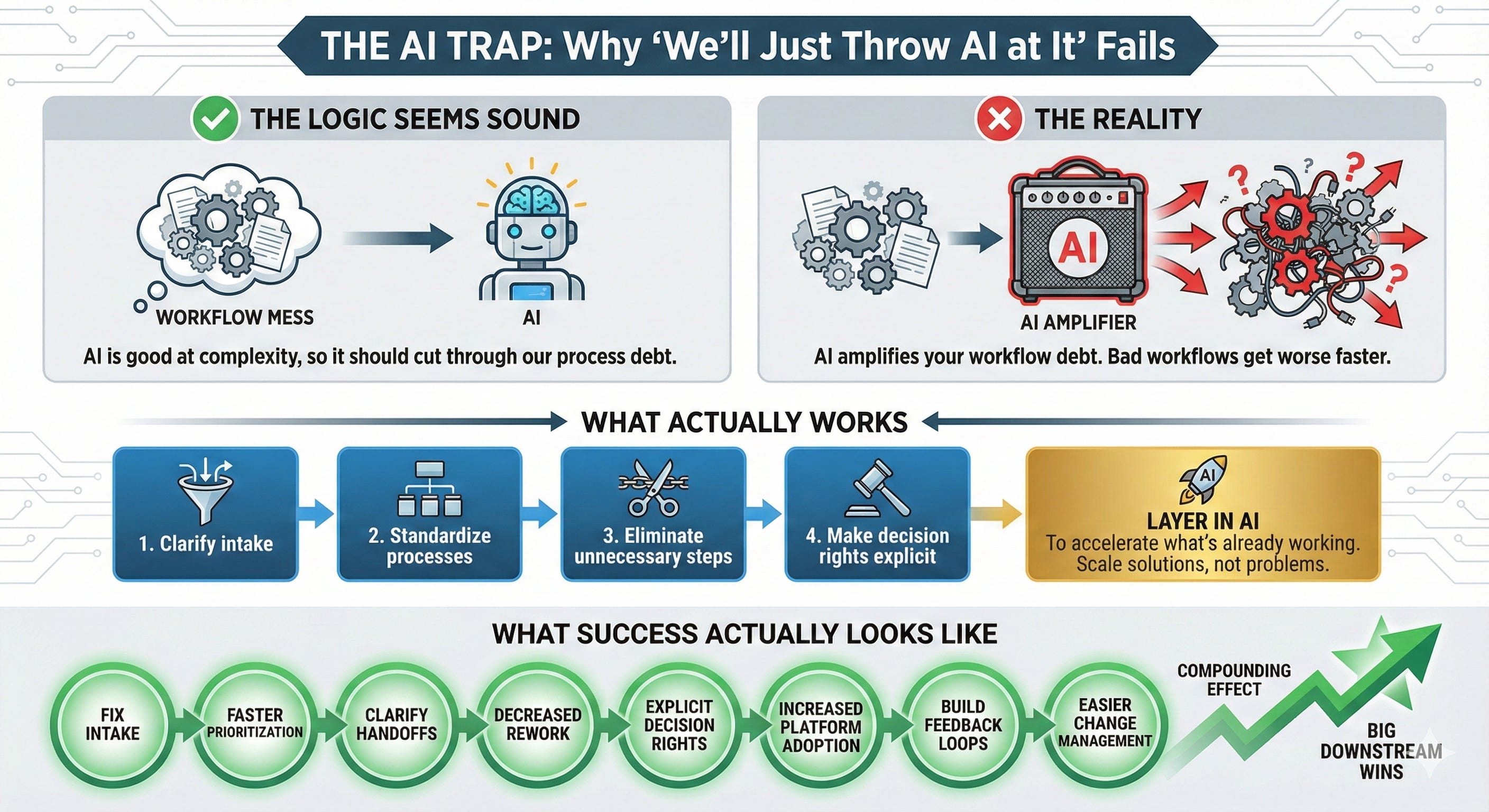
The AI Trap: Why “We’ll Just Throw AI at It” Fails
The Logic Seems Sound
Workflows are a mess. Teams are overwhelmed. Backlogs are growing. The response: “AI is good at handling complexity, so it should cut through our process debt.”
The Reality
AI amplifies your workflow debt.
If the intake is unclear → AI agents automate poor prioritization.
If data is inconsistent → LLMs surface bad insights.
If handoffs are broken → chatbots encode broken handoffs into automation.
The Irony
AI makes bad workflows worse faster.
What Actually Works
Organizations that succeed with AI fix workflows first:
Clarify intake.
Standardize processes.
Eliminate unnecessary steps.
Make decision rights explicit.
Then—and only then—they layer in AI to accelerate what’s already working.
Don’t use AI to bypass workflow problems. Use it to scale workflow solutions.
What Success Actually Looks Like
Workflow Clarity Compounds
When you fix intake → Prioritization gets faster because you’re solving problems, not processing requests.
When you clarify handoffs → Rework decreases because context doesn’t get lost.
When you make decision rights explicit → Platform adoption increases because teams trust that the platform serves real needs.
When you build continuous feedback loops → Change management gets easier because change becomes normal.
The Universal Pattern
I’ve rebuilt workflows across multiple functional areas and studio groups. The pattern is always the same:
Small workflow improvements unlock big downstream wins. Fixing one bottleneck speeds up everything downstream. Clarifying a single decision reduces confusion across multiple teams. Eliminating one unnecessary handoff frees up time that compounds across the organization.
This doesn’t happen in one initiative. It happens through continuous iteration.
Every quarter, something gets a little clearer, a little faster, a little more aligned. The compounding effect is huge, but it requires commitment—not to any specific workflow, but to the practice of continuously improving them.
The Real Work
Organizational transformation isn’t a big program with a launch date and a close-out report.
It’s the daily reshaping of how work gets done.
If You Want to Transform Your Organization
Start with workflow:
Map the current state.
Identify the bottlenecks.
Name the people problems.
Redesign deliberately.
Iterate continuously.
Workflow is the foundation of any modern data and AI operating model. Strategy matters. Technology matters. Culture matters.
But if the workflow is broken, nothing else sticks.
Two Truths I Come Back to Constantly
Technical isn’t the hard part. The people are.
Workflow change is a behavior change. You’re not just redesigning a process—you’re shifting power, changing incentives, asking people to work differently. That requires trust, clarity, and patience.
Change management is continuous, not episodic.
Build the muscle, don’t run the project. Organizations that transform aren’t the ones that run the best change management programs—they’re the ones that treat change as normal.
If You’re Stuck
If transformation keeps failing, if platforms aren’t getting adopted, if AI initiatives aren’t delivering—the problem is probably workflow.
The solution isn’t a better strategy or a better tool.
It’s the patient, continuous work of redesigning how work moves through your organization.
That’s the real work. Start there.
Thanks for reading! Subscribe for free to receive new posts and support my work.
Key Takeaways
Workflow is where change actually happens — org charts and roadmaps only matter if workflows support them.
Most failures happen at the workflow layer — unclear ownership, scattered handoffs, shadow decision-making.
Technical isn’t the hard part; the people are — resistance comes from power dynamics, not technical limitations.
Change management is continuous, not episodic — build organizational muscle for ongoing evolution.
Each layer depends on the one below — workflow → product → platform → AI (you can’t skip steps).
Technology amplifies clarity; it doesn’t create it — fix the workflow first, then add the tool.
AI scales whatever you give it — bad workflows produce bad automation.
Small improvements compound — every clear handoff, every explicit decision right unlocks downstream wins.