November 16, 2025 · The Data Product Agent
The Hidden Skill That Got Me Out of BI and Into Product
A few years ago, I took a role that, on paper, looked like a demotion. I left a private equity firm — the kind of place where “investment analyst” gets approving nods from people who care about that stuff — to build an analytics function at a mortgage startup. People asked polite questions, some asked less polite ones, and I didn’t have great answers for either group.
Then the startup collapsed. Everyone got laid off. Hard times.
That was the moment I had to choose: retreat to the safe path or double down on something I still didn’t know how to name. And this is the part of career growth we don’t talk about enough: sometimes you step backward on purpose because you can see the ceiling ahead… and sometimes you step backward accidentally, only to realize later that you were building toward something the whole time.
Thanks for reading! This post is public so feel free to share it.
Where It Actually Started
My career didn’t begin in private equity or in some polished strategy function. It started in BI at a startup that grew from 20 people to 300 while I was there — private money lending, fast-paced, messy, and full of the kind of ambiguity that teaches you to either adapt or drown.
My title didn’t mean much. Some days I was BI, other days product, sometimes finance or ops. I’d talk to the President about quarterly strategy, then jump into an engineering thread about event tracking, then walk through user behavior with design, and end the day pulling data that didn’t match any interpretation from the day before.
Nothing lined up neatly. Everyone operated with partial truth.
I wasn’t the best analyst — and that wasn’t the job, even if I didn’t know it yet. My real value was helping everyone understand each other. Back then, I wouldn’t have called it “translation.” I just assumed this was what BI was: connect dots, reduce confusion, figure out what actually matters, and try to get something shipped.
What I was really doing was product work long before I had the language for it.
The Prestigious Detour
After a few years, I made the move that looked like the right one: private equity. Real estate acquisition. $8B AUM. Clear path. Respectable brand. It felt like the kind of job you take if you want people to stop questioning your decisions.
The problem was I hated it.
Not because the work was bad, but because it wasn’t building. It wasn’t cross-functional. It wasn’t messy in the right ways. Investment analysis is research: neat, self-contained, and completely disconnected from the feeling of shipping something real and watching it get used.
I missed the chaos of teams talking past each other. I missed stitching together context. I missed solving problems that didn’t come with a template.
I stayed longer than I should have because the path was obvious and I didn’t yet have a name for the thing I was chasing.
The Backwards Move
Eventually I left and took a role that looked like a step back: Manager of Analytics & Product Strategy at a mortgage startup. I built their analytics function from scratch, integrated Power BI into a custom CRM, supported 85 loan officers, and created reporting that actually changed how people operated.
To outside observers, the move didn’t make sense. PE to mortgage analytics? But I told myself it was about impact, about building again, about getting closer to the work that made me feel alive.
Then the company went under. Layoffs. Again.
Hard times, part two.
But even in that moment, something finally clicked: I wasn’t going back to finance. I wasn’t chasing prestige. I wasn’t trying to fit into linear career logic that never fit me in the first place.
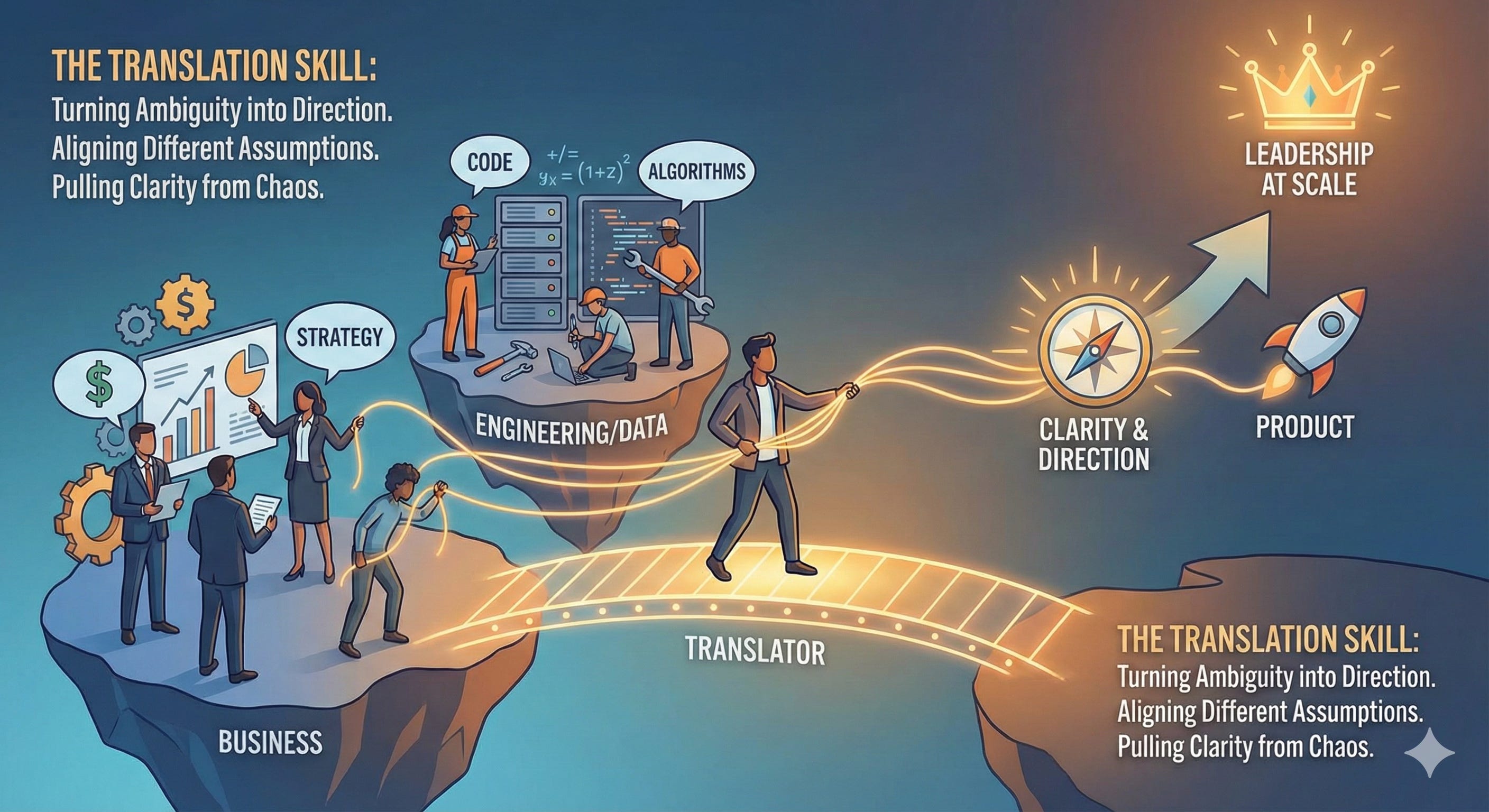
The work I enjoyed — the work I was actually good at — was the work that sat between business, engineering, and data. I just hadn’t yet connected that it had a name.
The Realization
Capital Group was the next big shift. A large, stable organization with a strong culture — and for the first time, a title that said out loud what I had been doing all along: Product Manager, Data Platforms & Strategic Automation.
I launched a data platform from 0→1, drove enterprise adoption, supported ETF launches, and built governance frameworks in a highly regulated environment. And through that work, it finally hit me: I had been doing product management for years, just under different labels.
The so-called “backwards” moves weren’t mistakes. They were evidence. Every environment — scrappy startups, collapsing companies, steady enterprise — had forced me to build the same muscle: translation.
Understanding why the business cared.
Figuring out what to build and what to ignore.
Helping engineering deliver something real.
Driving alignment across teams who naturally drift apart.
Once I saw that pattern, everything made more sense.
The Breakthrough
Capital Group was where the clarity formed, but I wanted scale — real scale. I wanted to lead people, not just deliver features. I wanted to make decisions at the intersection of business strategy, data reality, and product execution.
So I joined Taco Bell as a Staff Product Manager for the customer data platform. That’s where translation became leadership. I inherited a team treated like order-takers and built them into a strategic product organization. We drove CDP adoption across Yum Brands, launched ML models, delivered retention and lapse prediction capabilities, and influenced loyalty growth with data-driven personalization.
Then I stepped into the Portfolio Manager role, overseeing the entire data platform — 30+ people, enterprise strategy, Microsoft Fabric integration, GenAI enablement, the whole ecosystem. That’s when the “non-linear path” stopped feeling like something I needed to explain.
Because it wasn’t non-linear. It was consistent.
The settings changed; the underlying skill didn’t.
Where I Am Now
At Disney, working across data platforms and product strategy at enterprise scale, the through-line is impossible to ignore. The skill that matters most — the one I’ve been practicing since that 20-person startup — isn’t technical depth or certification count.
It’s translation.
It’s sitting between business, engineering, and data and making them understand each other.
It’s turning ambiguity into direction.
It’s aligning people who are working from different assumptions and incomplete information.
It’s pulling clarity out of chaos and turning it into product.
At scale, that skill becomes leadership.
Thanks for reading! Subscribe for free to receive new posts and support my work.
If There’s a Point Here, It’s Probably This
I still don’t know if every move I made was “right.” Sprout looked reckless. Getting laid off felt like failure. The pivots didn’t always make sense in real time. But looking back, I can see the thread clearly: I’d been doing product management since the beginning. I just didn’t have the vocabulary or confidence to call it that.
If you’re working in BI or analytics and you’re constantly clarifying priorities, shaping requirements, helping engineering ship, and evaluating whether the thing you built actually worked — you’re already doing product. You might not have the title yet. You might not recognize it. You might think you need another technical skill before you’re “ready.”
But the real ceiling isn’t technical.
It’s recognizing the skill you’re already practicing — translation — and leaning into it with intention.
Everything else is just learning the right name for the work you’ve been doing all along.